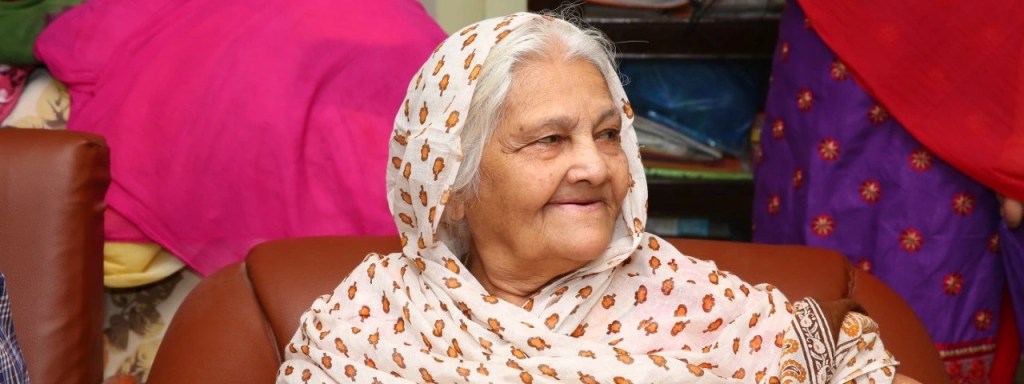
My earliest memory of Nanima is that of her coming to pick us from the airport. Always dressed in a plain but faintly printed georgette sari, she would reach the old Begumpet Airport well in advance, waiting patiently for us to emerge from the arrivals terminal.
She used to arrive in the quintessential Indian car born in Nehru’s India – the pride of every patriotic Indian – the Ambassador.
It was always the same white Ambassador. It was also always the same Farooqui sahab, the driver who would drive Nanima to the airport. Farooqui sahab as we all called him, (I never learnt his first name) owned the Ambassador and made a living as a driver.
A jovial man with so much genuine care that for sometime I thought he was an uncle who was distantly related to us.
For a 4 year old girl growing up in the UAE, it was a strange car, with its sofa-like front seating. Today I am trying hard to remember how one fastened their seatbelts on it.
Nevertheless, little me accepted the Ambassador as one of India’s many peculiarities and moved on to doing silly things that kids do in cars.
When we would reach home, a large pot of boiling hot Hyderabadi nihari and kulchas, also known as sheermal, would be waiting for us. This would be our breakfast, and the first meal that we would eat in Hyderabad.
Over the years, as Nanima aged and her health issues grew, she stopped coming to the airport. But she continued to order nihari for us. For my sister and I, along with our mother, this became routine. This was what we expected during our summer holidays.
But today, nobody arrives in Begumpet after the swanky new airport in Shamshabad was constructed. There is no Ambassador car, and with it no Farooqui sahab to pick us up. There is also no more Nanima to fuss over ordering nihari for us.
I lost Nanima when the second wave of Covid-19 struck. It was a two-week battle with the virus that my almost 89 year old grandmother could not win. She fought though. Very hard. At one point it seemed that she had fought it off completely because she had gotten much better.
That’s when the oxygen levels began to fall. After that, things disoriented quickly. The rest is too painful for me to write and for my family to read.
It’s been a year since she passed. This piece was long overdue but I could not bring myself to write it. When I finally decided to, I didn’t know where to start. Perhaps now, we can begin from the beginning.
Born sometime in the early 1930s (we do not know the exact year or date) Razia Sultana was the firstborn child of a rebellious love marriage between her Shi’a mother and Sunni father.
When she was about three years old, she lost her mother in a tragic fire which caught the Moti Mahal cinema hall, an incident that was reported by several British newspapers at the time including this one.
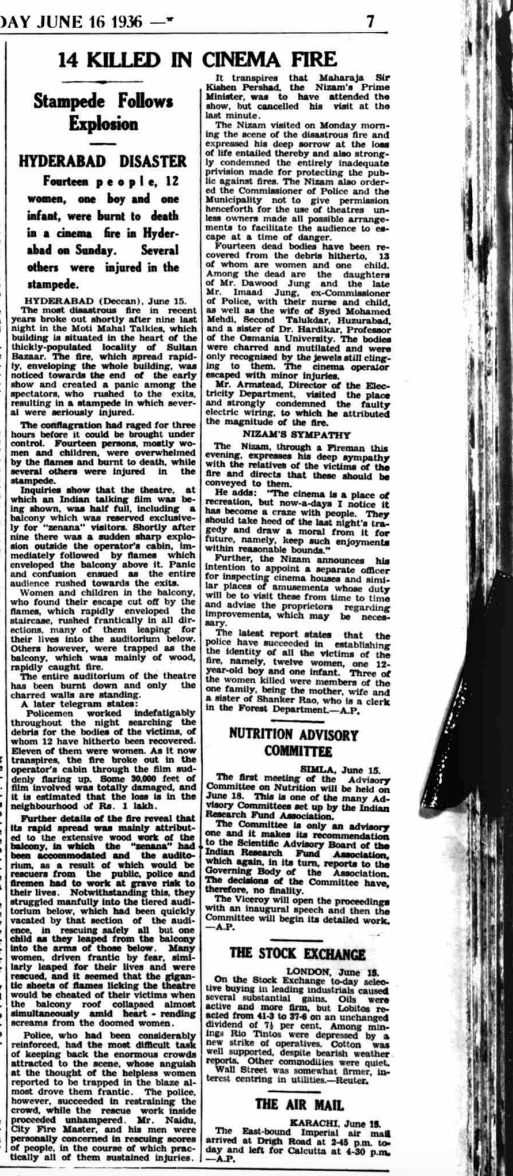
We were told a tale of heroism on the part of Razia’s mother Zafarunnisa Begum, who was seated on the balcony seat in the zenana. When the fire began to rage, she undid her sari, used it as a rope and helped several women escape. She herself perished in the fire.
This was supposedly narrated to the family by the “maidservants” at the time of the incident, which my grandmother then passed on to us. For years my mother, maternal aunts, cousins, and I lived on this story of bravery, that the women of our family had inherited the “courage gene” because of Zafarunnisa’s selfless act. I neither questioned the story nor the narrative.
Recently however, I discovered that the story may not be so straightforward. On a slow weekday, as I scrolled past Twitter, I stumbled upon a tweet thread by Hyderabadi journalist Serish Nanisetti. He narrated the same tale, except…the names involved did not match Zafarunnisa or her husband Lt. Siddique-uddin Mohammed.
Instead, it was Ashrafunnisa Begum (I have no idea who she is) whose husband was Lt. Muzaffaruddin. Ashrafunnisa apparently survived the fire and went on to receive the Empire Gallantry Medal, now known as the George Cross from the British Government.
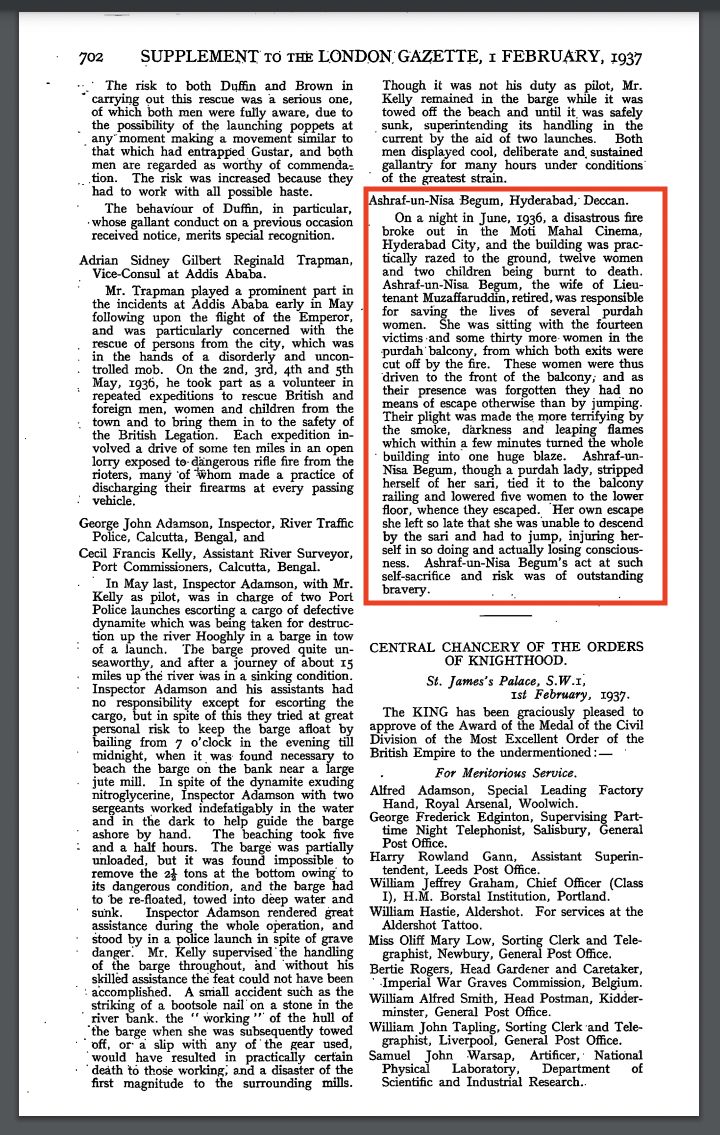
So…was the entire story of courage and bravery based on a lie? Or did someone else tell a lie? I tried to dig deeper, but never reached a conclusion. However, it prompted me to probe further into Nanima’s life.
Some years after her mother’s death, Nanima lost her father too, forcing her to live with her paternal grandmother and relatives. This story comes with a lot of caste and class connotations, so I beg the critical reader to forgive me for not discussing these in detail.
Nanima grew up in a wealthy household. Both her parents came from rich, landowning families whose descendents to this date mostly live comfortably to say the least.
Despite this, the repudiation of Zafarunnisa’s family for marrying a Sunni man, and the stigma by the lieutenant’s family for being a Shi’a woman’s daughter – ensured that Nanima (and her two siblings) would forever struggle to find their place in the family.
Court case after court case which were followed by bad advice from lawyers, also ensured that they would forever struggle to own any significant property.
This brings us to the late 1950s, where my Nani finally began to settle down and build a house of her own literally brick by brick.
This was then quickly followed by the sudden discovery of a brain tumour inside Nana, my grandfather. It rendered him something just short of a vegetative state, forcing Nanima to be both mother and father to her six children.
I would not be surprised if she found solace in her brave, selfless and courageous mother, a woman she never had the chance of knowing, a woman who nobody had the chance of knowing well since she’d died at the tender age of 21.
Perhaps a consequence of her situation, she became well known as a headstrong, no nonsense woman, who would not be afraid to say things as they were.
She was to me, also someone who was deeply aware of caste and class inequalities, despite being nostalgic for the pre-Independence Hyderabad which was deeply feudal, and her fondness for the last Nizam Mir Osman Ali Khan.
She repeatedly narrated an incident which even our family feels ashamed to, and admittedly I have thought twice whether to reproduce here or not. Apparently, she once visited the in-laws of one of her aunts who were jagirdars (zamindars/landowners).
They had a “maidservant” who, in those days, was as pretty much a slave. For “fun” apparently, they would ask the woman to perform crass acrobatics, which would reveal her intimate bodily parts. They would then go on to laugh at her. Nanima repeatedly explained the brutality of the Razakars, while at the same time absolving the Nizam of any wrongdoing.
Razia went on to lose her house in a road-widening project for the Hyderabad Metro in 2013, for which she had been fighting a court case for years. After losing the case, she also fought the Telangana government for better compensation.
Today, the Narayanguda metro station stands exactly in the location of the house she built by hand. Perhaps the only thing more painful than losing the house was the pomegranate tree attached to it.
She ran some businesses that ended up failing, after which she turned to renting part of the house. This was a woman who fought everyone at all levels: her family, government officials who scorned her whenever she wanted to get legal formalities done, the state government, and the society at large.
All pretty much without her husband or any male relatives. The open and more progressive atmosphere she created for her 5 daughters (and just one son) – ensured that our women were much more educated than her better-off relatives.
It pains me that this woman could not fight a being that is not even visible to the naked eye. It pains me that this woman who never left the house, never broke Covid protocols was the one affected most by it. She did not deserve this. She deserved a better farewell.
We commemorated her death anniversary last month (it was according to the Islamic calendar)where plenty of friends and relatives showed up, even those who hadn’t met us in years. With everyone sharing memories of Nanima along with some good food, nothing could have been a better celebration of her life. Even in death, she brought people together.
If Razia had not fought off patriarchal values at whatever level she could, I would probably not be here writing this. I have so much more to say about her…so many fascinating anecdotes to share…it would take me a book to write it all.
She single handedly changed the fates of the women in our family and we all derive our strength and power from her regardless of what her mother did or didn’t do. We are what we are because of her. For that, Nanima will forever be the true holder of the Gallantry Medal in my eyes.
 Untamed Reflections
7 responses to “Firebrand”
Excellent job painting the picture of one’s life with words
LikeLiked by 1 person
I read this with tears in my eyes…. No one could have described my mother’s bravery better… thank you my wonderful niece, for the most accurate and veracious words.
LikeLiked by 1 person
With proudly Brave wings she flies! May allah rest her soul in Jannah! ❤️ Ameen
LikeLike
Amazing.. such beautiful writing.. loved reading it. Look forward to reading more.
Thank you
LikeLiked by 1 person
Quintessentially heartwarming!
LikeLiked by 1 person
Godbless you beta…no words to describe her..she was stronger than the strongest. MAY ALLAH REST HER SOUL IN HIS PARADISE. AMEEN
LikeLiked by 1 person
Feeling proud to be her family part. May allah grant her highest place in jannah. الله يرحمك ويغفر له ويسكنه فسيح جناتك يارب العالمين آمين
LikeLiked by 1 person